The rhinoplasty trend of 2026: natural instead of perfect
What is the biggest rhinoplasty trend of 2026? Dr Bart explains why natural-looking rhinoplasty is becoming increasingly popular and why preserving character is more important than perfection.
For years, aesthetic surgery was characterised by a clear preference for a small, straight and highly refined nose. Social media, filters and celebrity faces contributed to a certain ideal: a narrow nasal bridge, a refined tip and as few visible imperfections as possible. In 2026, we are seeing a clear shift. Increasingly, patients are moving away from the idea of a ‘perfect’ nose and towards something far more personal: a nose that looks natural, suits their face and does not immediately reveal that surgery has taken place. I see this as a very positive development.
A nose does not need to be completely straight, small or symmetrical to be beautiful. In fact, subtle individual features can give a face character. Natural rhinoplasty is therefore not about eliminating every imperfection. It is about carefully deciding which changes will improve facial harmony and which characteristics are worth preserving. In this article, I explain why natural-looking rhinoplasty is becoming increasingly popular, how social media and AI influence our perception of beauty and why, as a plastic surgeon, I believe natural harmony is far more important than perfection.
From the perfect Instagram nose to a natural result
Social media has had a major influence on the way we look at our own faces. With a filter, we can make our nose narrower, lift the nasal tip, change the jawline and smooth the skin within seconds. When you regularly see an altered version of yourself, that digital version can gradually start to feel normal. It is therefore understandable that patients sometimes bring filtered images to a rhinoplasty consultation.
Certain nose shapes have also been particularly prominent online for years: a very narrow nose, a straight bridge and a small, slightly upturned tip. This almost created the impression that there was one ideal nose. But there is no single nose that is ideal for every face.
The shape of the eyes, chin, lips, cheekbones, forehead and jawline all influence how we perceive a nose. A nose that looks beautiful on one person may look completely out of proportion on someone else. That is why I find the shift we are seeing in 2026 so interesting. The question is becoming less, “Can you make my nose perfect?” and increasingly, “Can you make my nose fit my face better?”
What do we mean by natural rhinoplasty?
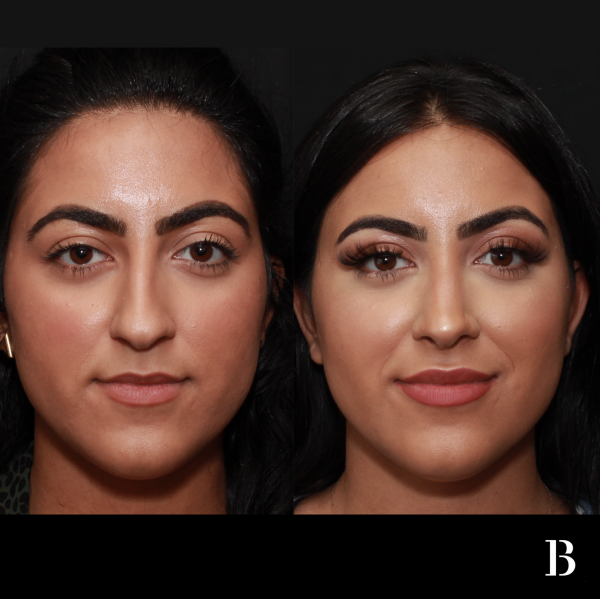
A natural rhinoplasty does not necessarily mean making only very small changes. This is an important distinction.For someone with a prominent dorsal hump, a significantly drooping nasal tip or considerable deviation, the difference before and after surgery can be substantial. Yet the final result can still look completely natural.
To me, natural means that the changes respect the patient's existing anatomy and complement the face as a whole. In one patient, this may mean completely correcting a dorsal hump. In another, preserving a small amount of the original profile may create a more harmonious result. One nasal tip may benefit from considerable refinement, while another needs to be treated conservatively to prevent the nose from becoming too narrow. A natural rhinoplasty is therefore not necessarily a minor rhinoplasty. It is a personalised rhinoplasty.
Why smaller does not automatically mean more beautiful
A common misconception is that rhinoplasty is primarily about making the nose smaller. But smaller does not automatically mean more beautiful. Imagine someone with a relatively long face, a defined jawline and a strong chin. An extremely small nose could actually disrupt the balance of that face. Similarly, a slightly stronger nose may look beautiful on someone with more pronounced facial features. This is why I always analyse more than just the nose during a consultation.
I look at the relationship between the nose and the chin, forehead and lips. The length and width of the face also play an important role. A nose may already look beautifully proportioned from the front while benefiting from a subtle adjustment in profile, or vice versa. The aim is not to make the nose as small as possible. The aim is to make the nose feel less like an isolated feature and more like a natural part of the face.
Character does not need to be removed
Personally, I think this is one of the most important developments in modern rhinoplasty. Not every imperfection needs to disappear. The nose can contribute significantly to the character of a face. A slight difference between the left and right side, a particular shape of the nasal tip or a subtle line in the profile may be part of someone's individual appearance.
Of course, this does not mean that a patient should simply accept a feature that has bothered them for years. A prominent hump, wide nasal tip or significant deviation can often be corrected very effectively. But correcting something is different from erasing everything that makes a nose individual. During surgery, I therefore consider not only what I can change, but also what I want to preserve. That balance is what separates a nose that is technically ‘perfect’ from a nose that truly belongs to the person.
Symmetry is not the same as beauty
The same applies to symmetry. We often associate symmetry with beauty, but almost no human face is completely symmetrical. One eye may sit slightly higher than the other, one side of the jaw may have a subtly different shape and the left and right sides of the nose are rarely identical. That is completely normal.
During rhinoplasty, we naturally aim to correct significant deviation or noticeable asymmetry whenever this is possible and appropriate. However, the goal is not to make every millimetre identical. A perfectly symmetrical nose within a naturally asymmetrical face could even look unnatural. That is why I always evaluate the nose in relation to the patient's existing facial proportions. We aim for harmony, not mathematical perfection.
What role do filters and AI play in 2026?
For years, filters have influenced how people see themselves. In 2026, another development has become increasingly relevant: artificial intelligence. AI makes it remarkably easy to generate realistic images of yourself with a different nose, jawline or even completely altered facial proportions. Within seconds, you can create an image that appears to show what you might look like with a smaller or differently shaped nose.
These images can be interesting and may even help someone communicate what they like. However, an AI-generated image is not a surgical treatment plan. AI does not know the thickness of your skin, the strength and shape of your cartilage, your underlying bone structure or how your body will heal after surgery. A digitally generated result may therefore be very different from what is surgically achievable—or what would actually look natural on your face.
I have no problem with patients bringing filtered photographs, AI-generated images or other examples to a consultation. They can be useful starting points for a conversation. But I see these images as inspiration, never as a result that should be copied exactly.
My philosophy as a plastic surgeon
"I see it as a positive development that more patients are asking for a nose that suits them rather than a 'perfect' nose.
For me, this has always been the starting point. When I first meet a patient, I do not immediately focus on everything I could change. I first look at what is already working well. Which lines complement the face? Which characteristics give someone their individuality? And which features genuinely cause concern?
From there, I try to change only what will improve the face as a whole. A nose does not need to be perfectly straight, small or completely symmetrical to be beautiful. It needs to suit the person. For me, the best result is when people notice that someone looks good after surgery without immediately being able to identify that their nose has been operated on."
Preservation rhinoplasty fits this development
This philosophy also aligns closely with the principles of preservation rhinoplasty, a surgical approach that has gained increasing international attention in recent years. In some traditional rhinoplasty techniques, certain nasal structures are removed and subsequently reconstructed. With preservation rhinoplasty, we aim to preserve healthy and functional structures wherever possible.
The principle behind this approach appeals to me: preserve what is good and change what is necessary. This does not mean that preservation rhinoplasty is automatically the best technique for every patient. Some noses require a different surgical approach. The technique should never become more important than the result. However, the philosophy behind preservation rhinoplasty fits well with the development we are currently seeing: rather than creating a standardised nose, we work with the anatomy that is already there.
A natural result can still create a significant difference
The word ‘natural’ is sometimes confused with ‘barely changing anything’. They are not the same. If someone has a prominent dorsal hump and we correct it, the profile can change significantly. The same applies to a strongly drooping nasal tip, a wide nose or a noticeable deviation.
The difference between the before-and-after photographs can therefore be substantial. Yet the patient does not have to look ‘operated on’. To me, that is precisely the art of rhinoplasty: creating a clear improvement without allowing the new nose to become disconnected from the rest of the face. You can see the difference. You do not necessarily need to see the surgery.
Trends change, but rhinoplasty is permanent
This is also why I am cautious when it comes to aesthetic trends. The ideal nose of ten years ago is not necessarily the same nose that dominates social media today. And in another ten years, our perception of beauty will probably have changed again. Rhinoplasty, however, is intended to create a permanent change.
I therefore do not believe that surgery should be performed simply because a particular nose shape happens to be popular in 2026. That does not mean trends are irrelevant. Beauty ideals naturally evolve, and it is understandable that our preferences evolve with them. But the final result should be timeless enough to still feel right long after a particular trend has disappeared.
How do we determine which nose suits you?
That process begins during the consultation. First, we discuss what bothers you about your nose and what you would like to change. I then analyse the nose from different angles and evaluate the face as a whole. Aesthetic considerations are only part of that assessment. Skin thickness, cartilage quality, bone structure and nasal function also determine what can realistically be achieved.
We then discuss which changes are possible and, just as importantly, which changes I would or would not recommend. Sometimes this means changing less than a patient initially expected. In other cases, several adjustments are necessary to achieve a result that ultimately looks natural. There is no standard formula for natural rhinoplasty. It is precisely the individual approach that makes the result look natural.
Conclusion
The rhinoplasty trend of 2026 reflects an interesting shift: natural is becoming more important than perfect. The goal is no longer for everyone to have the same small, straight and perfectly symmetrical nose. Increasingly, patients want to preserve their own face and individual character while making subtle—or sometimes significant—changes that allow the nose to fit the face more harmoniously.
In my opinion, this is a positive development. A successful rhinoplasty should not be about following a beauty ideal. It should be about understanding which characteristics make someone unique, which aspects genuinely cause concern and which changes will improve the face as a whole. Perfection is not the goal. A nose that truly suits you is.
Curious about what is possible in your situation?
Every nose is unique, which is why there is no standard approach to rhinoplasty. During a personal consultation, we analyse your nose in relation to your face as a whole. We discuss what you would like to change, but also consider which characteristics already suit you and should be preserved.
Based on your anatomy, facial proportions and personal wishes, we will honestly discuss what can realistically be achieved and which surgical approach is most appropriate. A successful rhinoplasty always begins with honest advice.
Schedule a personal consultation at Dr Bart Clinic and discover which rhinoplasty approach best suits your face.